

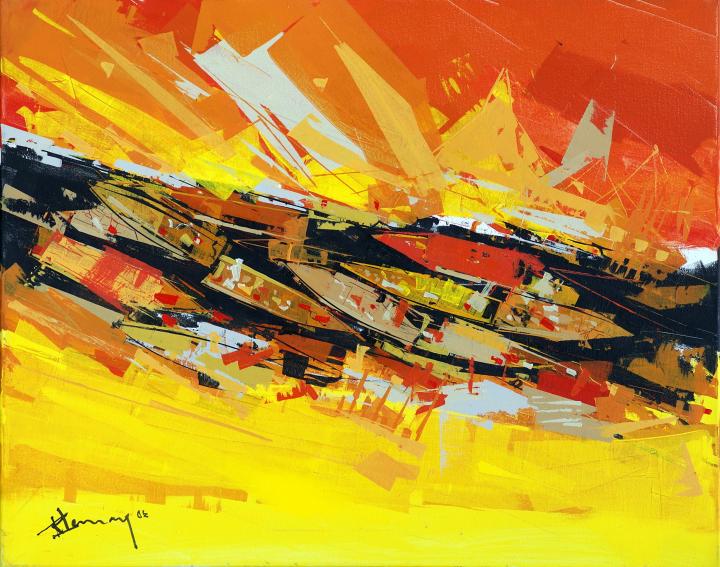
For most of them, the logical market to conquer, given geographical position, remains the United States, particularly the East Coast. There is also, of course, the Canadian market and the cities of Toronto, Calgary and Vancouver. Some, more original or adventurous, turn to the East: Indonesia, Vietnam, Thailand or China. René Lemay is one of those artists who move toward this mysterious continent. He has travelled to Asia every year since 1998. Year after year, the adventure becomes more concrete. Through encounters, the market opens up, slowly but surely.
“During my first trips, I mainly focused my efforts on Bali. A friend from the Îles-de-la-Madeleine, Jean-François Cyr, had told me about his travels in Indonesia. I found it fascinating and I went there for the first time in 1998. It was quite a shock! I was amazed by the landscape.” Right away, he meets several artists, including Paul Husner, a European who has lived and painted in Bali for years. René Lemay quickly understands that if he wants to establish himself in this country, he will need to be present. He looks for a studio and finds one in a rice field with a splendid view of Mount Agung. He immediately discovers at the Neka Museum an artist who fascinates him, Made Sumadiyasa. It is an abstract painting, bursting with colour and very gestural. Later, he meets the artist who becomes a friend. He also meets a well-known painter in Indonesia, Arie Smit. Of Dutch origin, he was a prisoner of war (during the Second World War) and upon liberation decided to remain there. During this first journey, mainly exploratory, René Lemay paints relatively little (less than twenty paintings), but the foundations are laid.
He returns the following year and settles in Panestatan, a neighbourhood in the hills of Bali. In front of his house, again that view of Mount Agung dominating the horizon. His home is surrounded by vegetation, hibiscus, orchids, banana trees, and other extraordinary flowers. He paints large formats. Inspiration is present. At that time, he meets Agung Rai, a wealthy collector who supports many artists. He owns a museum, the Arma Museum, and is also the owner of the Agung Rai Gallery. He greatly appreciates Lemay’s painting. The adventure becomes more and more concrete. In addition to exhibiting his work, he places him in major auctions in Singapore, promotes him, and ensures his presence even when the artist returns to Canada.
The following year, while maintaining his presence in Bali, René Lemay decides to extend his efforts to Vietnam. It is there that he will learn the lacquer technique at the Hanoi School of Fine Arts, which even provides him with a studio. He is overjoyed. This technique fascinates him. He produces about ten paintings, which he later exhibits at Galerie l’Harmattan in Baie-Saint-Paul. It is from Vietnam that things begin to develop more strongly. Gradually, he manages to present his first major solo exhibition in Asia, in Bangkok, Thailand, at the Carpediem Gallery in March 2006. This same exhibition (with sold works replaced) is presented in August of the same year in Hanoi, at the Viet Fine Arts Gallery. He also presents it in Bali and Singapore, and everything is set in place to bring it to Shanghai, China. In the meantime, he exhibits solo next July with the Carpediem Gallery, at the Sofitel Hotel, a high-end establishment in Bangkok capable of offering a larger space than the gallery. This is a first experience of this kind for the gallery.
René Lemay has no intention of stopping there—quite the opposite. Many other projects are taking shape, and the coming years promise to be rich in events. To be followed with interest.