
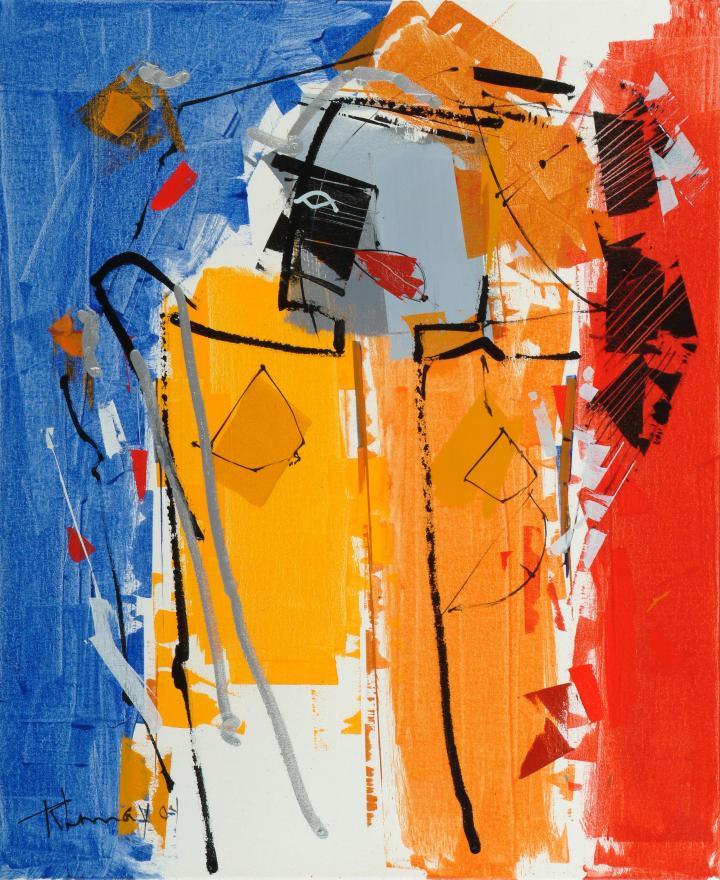
With his brother, Yann Beauregard-Lemay began cataloguing his father’s artworks. “Each work is a story,” he notes, observing that each person has a very particular relationship with the work they acquired. They set up a website that brings together the works they have traced, as well as notes taken from their father’s notebooks and travel journals.
“I find it wonderful that my father had an artistic career, because you really leave a part of yourself—things you have seen, colours, movements that you have put into a painting. Memory over time is shaped and changes. We build a memory around that object, which is sometimes not entirely true, but that is what is beautiful about memory: it changes.”
Art as a way of extending memory
In the 2000s, René Lemay undertook a series of trips to Asia. There he discovered the Chinese lacquer technique, which he incorporated into his work. “Through the lacquer process, which is a technique of preservation, I think my father wanted to leave something that would endure,” says his son.
He observes that artworks, with the sensitivity they capture, become carriers of a person’s memory, but also of a collective, and even historical memory. “There is a dialogue that continues to develop between the works and the projects we have. My father will not come back. But memory is a contact with the person you loved. It is a compass that helps you know where to go.”
— Yann Beauregard-Lemay