

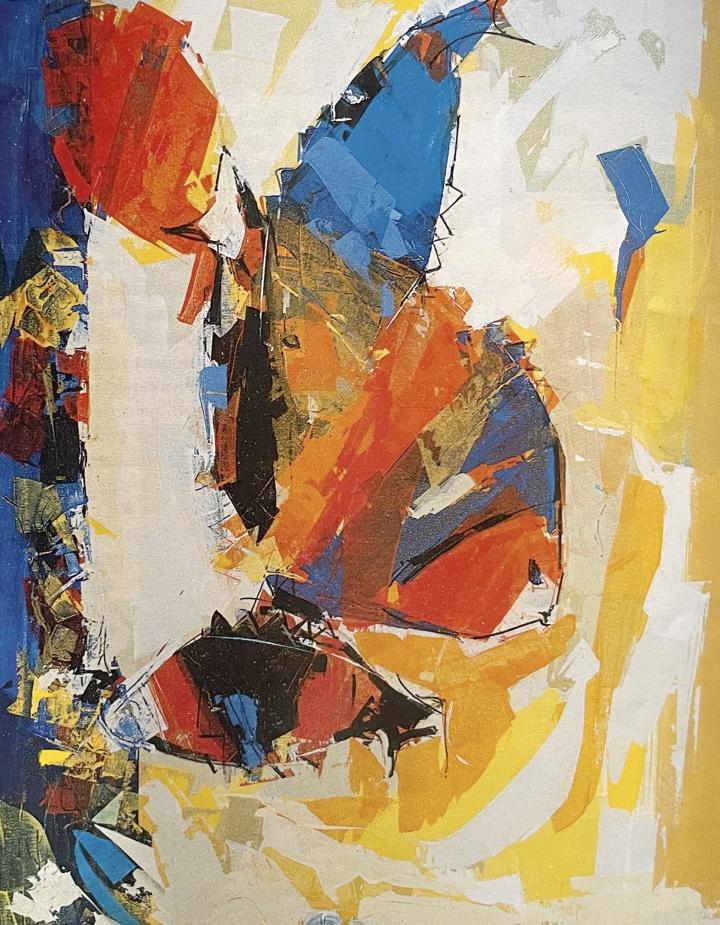
A few years later, at the beginning of his painting career, his style and subjects were essentially traditional. Gradually, his research evolved toward a more personal style and led him, in recent years, to a mastery of the medium that gave him greater freedom and, above all, opened new avenues of visual exploration.
During a recent trip to Asia, René Lemay refined his technique through the discovery of a world that left a deep mark on him and whose impact on his artistic development remains indelible. In fact, the artist achieved in Asia what he could hardly accomplish here: being in contact with other artists in a climate of fraternity and openness that our local individualism no longer allows. His Asian contacts proved highly stimulating, both on a human level and from a pictorial point of view. He met traditionalist Balinese artists who, generation after generation, have learned to express themselves through a unique language; a Javanese artist whose political oppression translates into a strongly politicized approach allowing him to express the suffering of an entire people; a Dutch-born artist, Arie Smith, settled in Bali since the Second World War, when he had been taken prisoner by the Japanese. All these life experiences fascinated Lemay, not to mention the sense of displacement created by volcanoes, rice fields, and lush nature. One encounter led to another, without forcing things, and he formed friendships with artists from all over the world for whom Bali was a key stop. They worked in groups in a studio or outdoors, painting from life. Some even amused themselves by borrowing each other’s styles, each working within a technique rooted in a unique culture that, whatever it may be, remains open to blending.
Naturally, René Lemay’s colours changed: they became more vivid, more flamboyant, as his latest works testify. His pictorial approach remains above all intuitive. The artist makes many sketches, often on location. These sketches serve as a starting point in the development of his paintings. He then adopts a process akin to automatism, letting himself be guided by the impressions of the moment, improvising according to his spontaneity. From the initial sketch, nothing may remain. Lemay likes to compare his method of work to that of a musician improvising on a given theme. Indeed, his painting is strongly marked by rhythm and movement. From the unpremeditated gesture emerge on the canvas suggestive forms evocative of his past experiences, notably travel and encounters. Lemay favours the spatula, an instrument that gives him great freedom and allows him to fully unleash his imagination. The result produces effects strikingly similar to collage. He uses only pure colour, mixing it directly on the canvas, sometimes through layering. Once forms become more defined, he lets himself be influenced by them and outlines certain shapes with linear strokes, giving rise to a rooster, a sailboat, figures.
René Lemay will soon leave again for Asia. Building on his previous journey, the artist hopes that once again these new horizons will open his own, and guide his imagination toward new frontiers.